
I’m happy to announce that EMF-2.5 will come along with support for the brand new Eclipse-Databinding API coming with Eclipse-Galileo. A big kudos goes to Matthew Hall who reviewed my patches and helped me shapeing the support and it’s documentation (more in bug 262160).
I got voted in some weeks ago as a committer on EMF and so now I’m in charge of the Databinding-Support for EMF and I’ll try to fix problems with the API and give answer to questions on the Newsgroup.
Before I start explaining some nifty and nice things about the API and how one can use (and probably extend) it let me state that the API is marked as provisional and there are chances (though small ones) that we’ll introduce a breaking API change in the next release.
This is going to be a series of blog postings showing some new EMF-Databinding stuff in action:
- Part 1: Create the Domain-Model
- Part 2: Introduce the new Properties API
- Part 3: Setting up a TreeViewer with EMF-Databinding
- Part 4: Using the properties API in master-detail
- Part 5: Setting up a TableViewer with EMF-Databinding
- Part 6: Write your own Property for unsupport Widget-Types
- Part 7: Make the storage system plugable
To give you a possible jump-start on EMF-Databinding I’ve been working on an example application in the last few days.
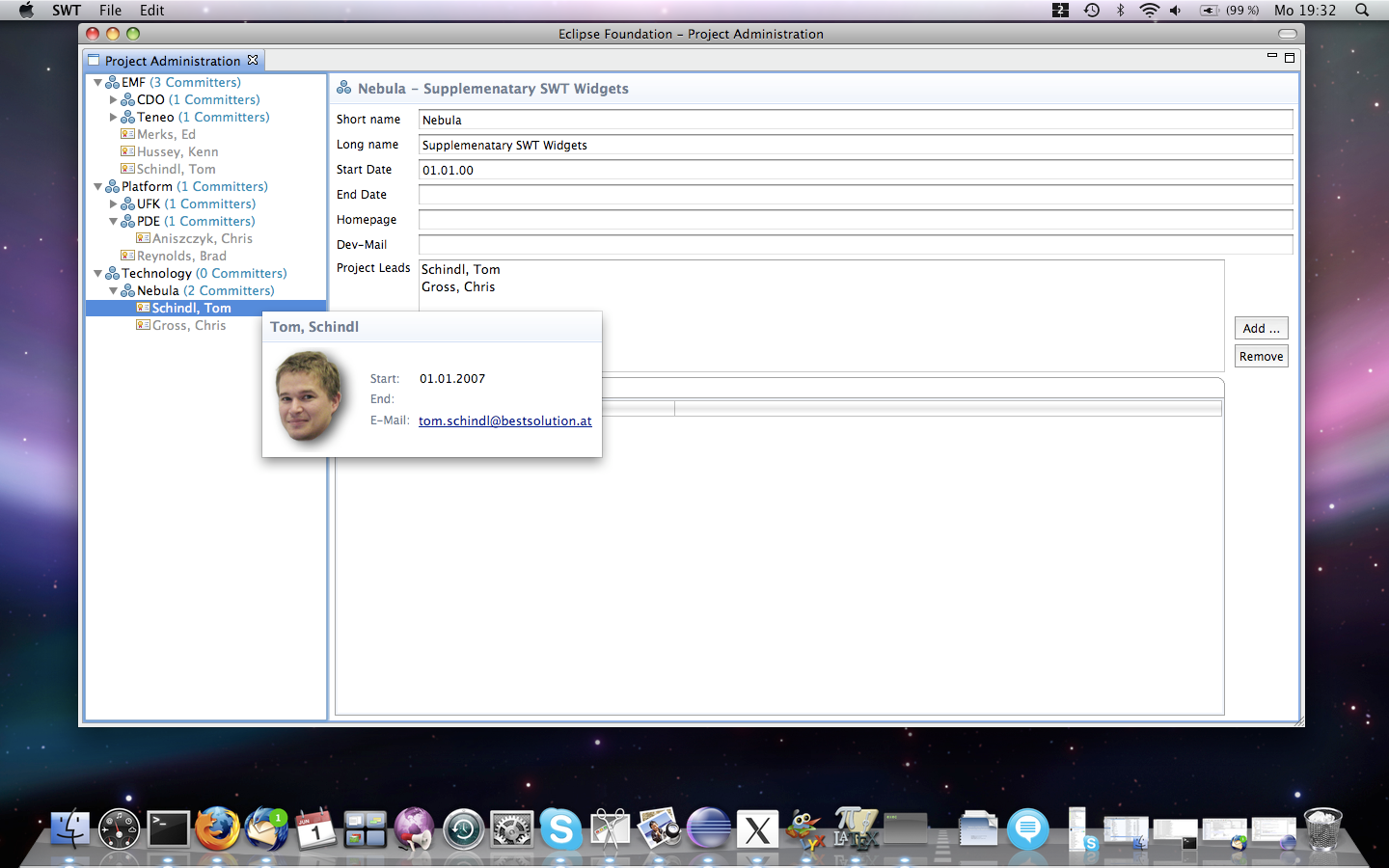
All example code is available from Eclipse-CVS and released under EPL.
 Tomsondev Blog
This is a great idea, Tom. As an adopter of DataBinding and EMF-DataBinding back in Eclipse 3.3, I bemoaned the lack of good comprehensive examples. This looks to be a great resource for those new to DB and/or the new APIs.
One suggestion: a post specifically about debugging techniques would be very helpful. I’ve found it to be difficult to debug problems when using EMF-DB because of all the indirection involved; it would be helpful if you’ve developed some techniques or tricks that can help application developers figure out where we’ve made mistakes in our bindings.
Hello,
you say “All example code is available from Eclipse-CVS and released under EPL.”
but I can’t find the code on the Eclipse-CVS, could you show me exactly where it is please ?
I don’t see an EPL project ??
EPL is the license. EMF has moved to git since then. So the code is here
ok thank you, I checkout the projects,
I open the file plugin.xml in the directory “org.eclipse.emf.examples.databinding.project.ui.rcp”
and try to launch with “Launch an Eclipse application” but I don’t see the perspective and view of the example. It launch a new instance of Eclipse.
Could you help me please ?
I’m beginner with RCP…
Thank you
There’s a heap of tutorials on RCP around. http://www.vogella.de/eclipse.html
Hello Tom, thanks for the tutorial. This is only one of the few tutorials on the net solely about EMF Date Binding and this is great. But I am having a problem when I try to run the phone book example.
Do you have any idea, what that might be:
#
# A fatal error has been detected by the Java Runtime Environment:
#
# SIGBUS (0xa) at pc=0x000000010a0f644e, pid=5662, tid=140735255652704
#
# JRE version: 7.0_04-b21
# Java VM: Java HotSpot(TM) 64-Bit Server VM (23.0-b21 mixed mode bsd-amd64 compressed oops)
# Problematic frame:
# J org.eclipse.osgi.internal.resolver.VersionConstraintImpl.getName()Ljava/lang/String;
#
# Failed to write core dump. Core dumps have been disabled. To enable core dumping, try “ulimit -c unlimited” before starting Java again
#
I believe, this has nothing directly to do with your application, right?
Best regards!
correct – this is another problem